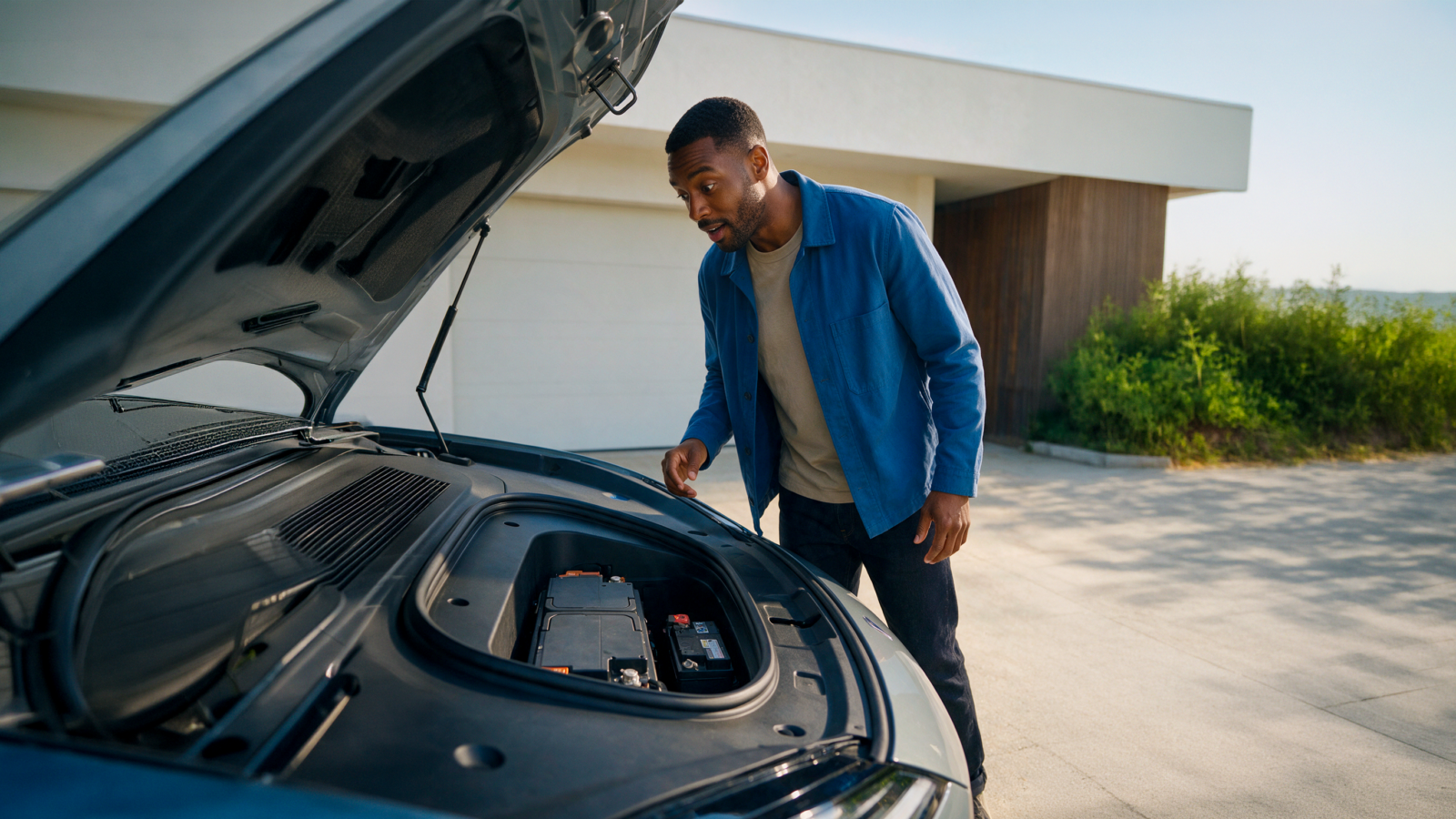
One EV, two very different battery jobs
When we talk about an EV battery, we usually mean the large high-voltage battery that powers the motor.
But many electric cars also use a separate 12V electrical system.
The European Automobile Manufacturers’ Association, ACEA, explains that full electric and plug-in hybrid vehicles use a second 12V system for things like controls, comfort features, redundancy and safety functions.
So while one battery helps move the car, the smaller system helps many of the car’s everyday electronics do their job.
Why not power everything from the big battery?
Because the two systems are designed for very different jobs.
The traction battery operates at high voltage because it needs to deliver enough energy to move the car. Many other vehicle systems work at much lower voltages.
Research from the European Commission’s Joint Research Centre shows how a DC/DC converter reduces the voltage from the main battery pack so it can supply the 12V system. That lower-voltage network then powers auxiliary equipment such as headlights, audio and heating.
Think of it as the electrical equivalent of using the right charger for the right device. The energy may ultimately come from the same car, but different systems need it delivered in different ways.
So what does the smaller battery actually do?
More than you might expect.
ACEA says low-voltage vehicle networks can support controls, comfort features, redundancy and safety functions. Its Automotive Battery Technology Trends Review also highlights the role of low-voltage systems in powering equipment such as warning lights, airbags and door locking.
Bosch also uses 12V systems in its Powernet Guardian technology, where low-voltage power can support functions including electric steering assistance and brake boosting.
That makes the smaller electrical system much more than an old component left over from petrol cars.
Can an EV have plenty of range and still have a 12V problem?
Yes, because the high-voltage and low-voltage systems do different things.
Having plenty of charge in the traction battery does not automatically mean every part of the low-voltage system is working correctly.
The 12V system helps activate and support many electrical functions around the vehicle, which is why reliability matters. Bosch is developing lithium-ion 12V batteries for EV power networks with a focus on safety-related systems and longer service life.
So an EV can carry a battery capable of moving the car hundreds of kilometres while still depending on a much smaller battery to help get everything ready.
Will EVs always need a 12V battery?
Not necessarily in exactly the form we know today.
Vehicle electrical systems are changing quickly, and manufacturers are exploring different battery chemistries, voltages and power-network designs.
But the underlying need remains: cars still require a reliable low-voltage electrical supply for many functions that do not need the full power of the traction battery.
ACEA’s battery technology review suggests these low-voltage systems will continue to play an important role as cars add more connectivity, driver-assistance technology and always-on electronics.
Quick Q&A
Questions, answered.
Tap a question for a quick, evidence-based answer.
Does every EV have a 12V battery?
Many EVs use a 12V low-voltage system alongside the main traction battery, although the exact design can vary between manufacturers and models.
What does the 12V system power?
It can support controls, comfort features, lighting, electronics and safety-related functions.
Does the main EV battery help supply the 12V system?
Yes. A DC/DC converter can reduce the high voltage from the traction battery and supply the lower-voltage network.
Why not simply use the high-voltage battery for everything?
Because many vehicle electronics are designed to work at much lower voltages. Using separate voltage levels allows each system to operate in the way it was designed for.
Could the traditional 12V battery disappear?
The technology may change, but EVs will still need some form of reliable low-voltage power for auxiliary and safety-related functions.
A quick reality charge
The smaller battery has a surprisingly big job
The high-voltage battery is the one that gets the range figures, charging speeds and headlines.
But behind the screens, lights, locks and electronic systems, another electrical network is quietly helping the car work.
Your EV’s biggest battery may move the car. The smaller one helps bring everything else to life.