Not necessarily. An EV battery can have more than one life.
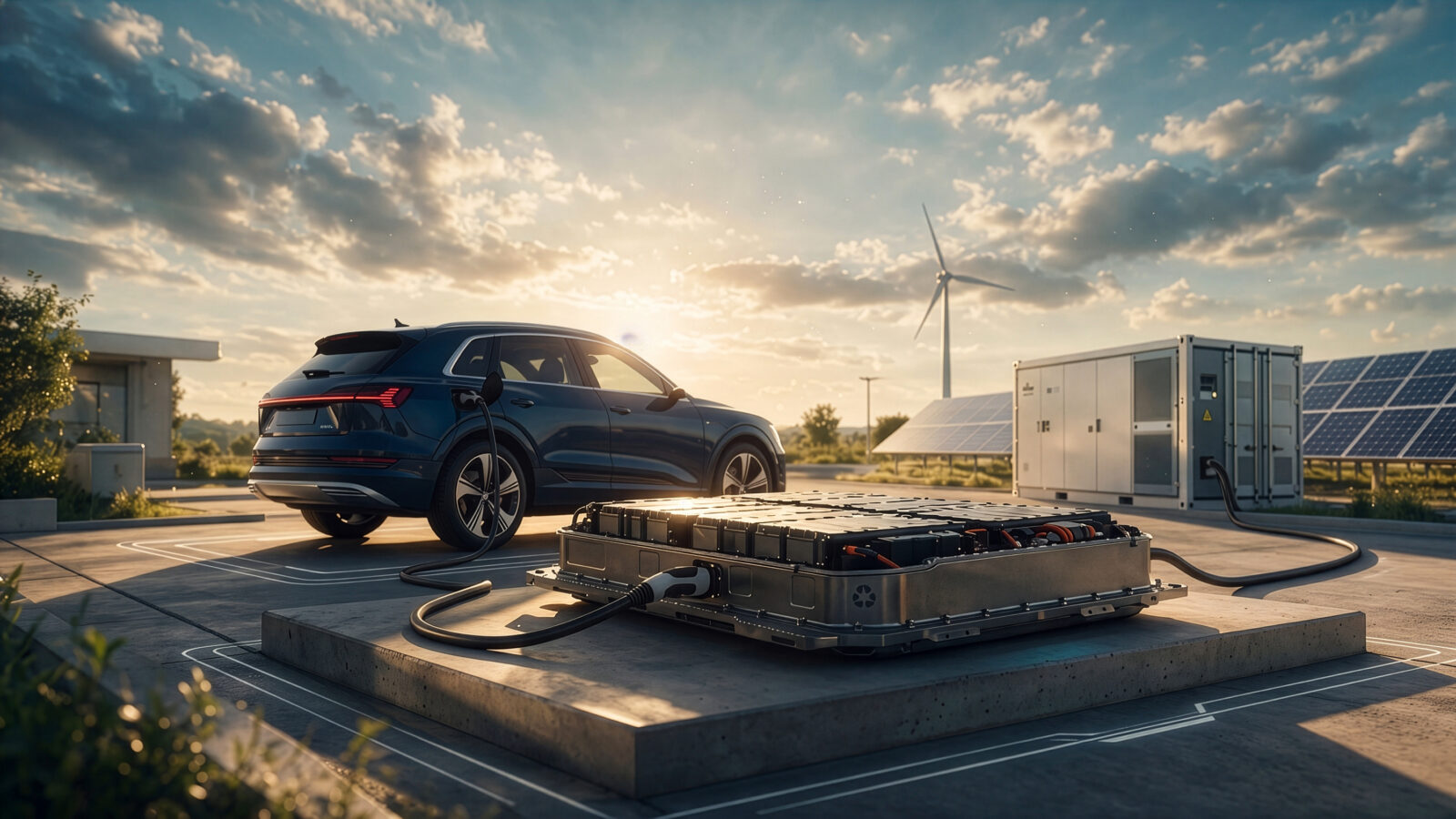
When a battery is no longer ideal for powering a car, that does not automatically mean it has reached the end of the road. In some cases, it can be reused for stationary energy storage before its materials are eventually recycled.
Myth: “Once an EV battery is done, it goes to landfill”
That is a common assumption, but an EV battery becoming unsuitable for driving does not necessarily make it useless.
Cars need batteries that can deliver power reliably, hold enough energy for useful range and perform safely under demanding conditions.
Stationary energy storage has different requirements.
A battery that has lost some of its original capacity may still be useful when weight and driving range no longer matter.
So what is a battery’s “second life”?
Imagine an EV battery that no longer gives a car the range it once did.
Instead of immediately breaking it down for recycling, it may be possible to repurpose it as part of a stationary battery system.
That stored energy could help a building use more of its own solar power, provide backup electricity or support the wider electricity network.
The International Energy Agency includes reuse in stationary storage among the possible pathways for used EV batteries, although how widely it is adopted will depend on costs and available battery supply.
Same battery. Very different job.
And what happens after that?
Eventually, batteries reach a point where reuse no longer makes sense.
That is when recycling becomes particularly important.
EV batteries contain materials including lithium, nickel, copper and, in some battery chemistries, cobalt. Recycling aims to recover useful materials so they can return to battery and industrial supply chains.
The IEA says recycled materials could reduce future demand for newly mined battery minerals if recycling systems scale effectively.
That becomes increasingly important as the number of EVs, and therefore batteries, continues to grow.
Does every used EV battery get a second life?
No.
Some batteries may be better suited to recycling immediately. Others may still have enough useful capacity for another application.
Battery health, chemistry, safety and cost all influence what happens next.
So “second life” is an option, not a guarantee.
Quick Q&A
Questions, answered.
Tap a question for a quick, evidence-based answer.
Do old EV batteries go straight to landfill?
Not necessarily. Depending on their condition, they may be reused for stationary energy storage or sent for recycling.
What can a second-life EV battery be used for?
It can potentially store electricity outside a vehicle, for example as part of a home, commercial or grid energy-storage system.
Can EV battery materials be recycled?
Yes. Recycling processes can recover valuable materials including lithium, nickel, copper and cobalt, depending on the battery chemistry.
Does an EV battery become useless when its range drops?
No. A battery may no longer meet the demanding requirements of a car while still retaining useful energy-storage capacity.
An EV battery does not necessarily have one job and one life.
First, it can move a car. Then, in some cases, it can store electricity somewhere else.
And when it finally reaches the end of its useful life, many of its materials can potentially go back into the supply chain.
Not quite the one-way trip to the bin that the myth suggests.