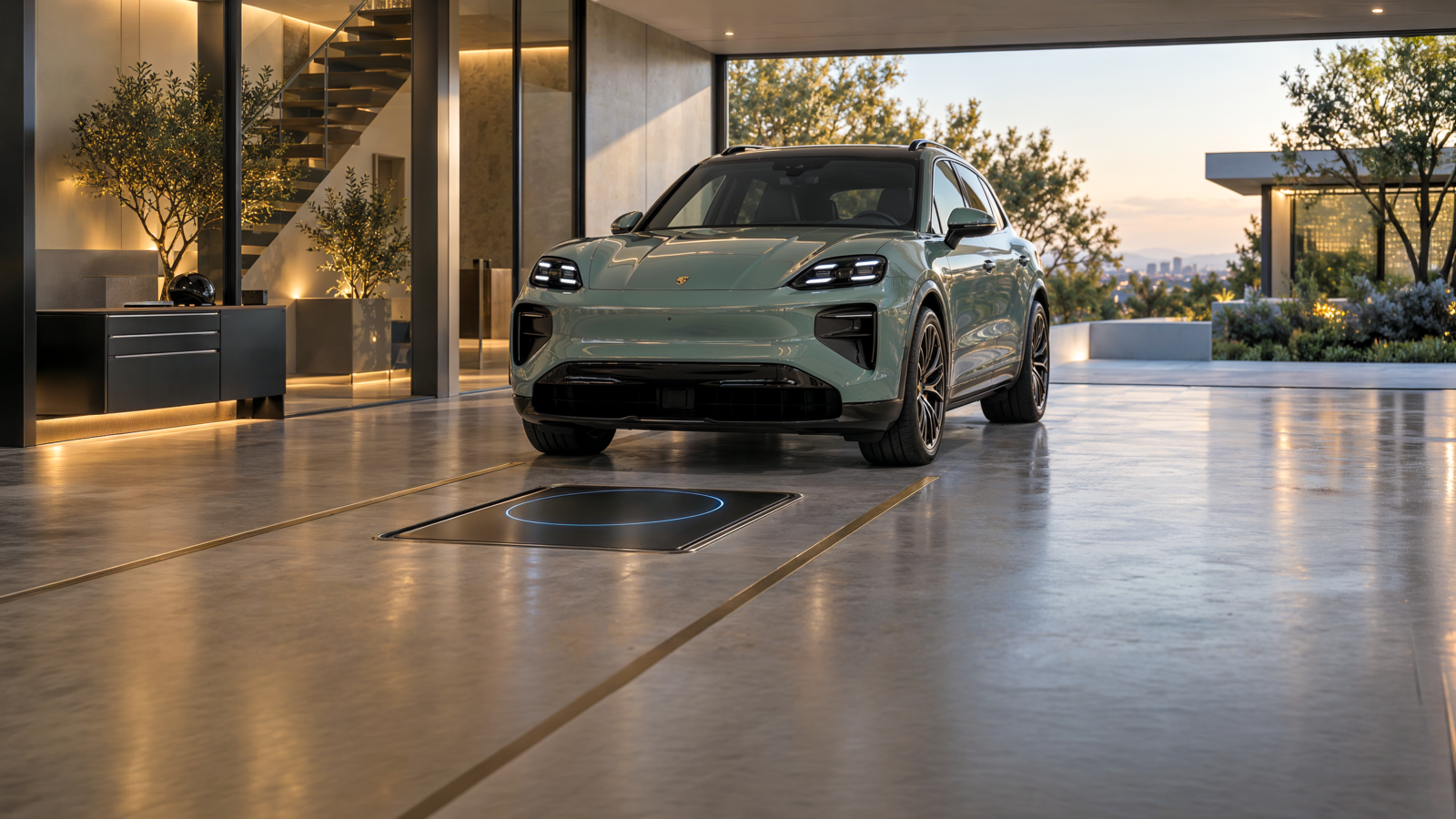
Park the car. Walk away. Charging starts.
That sounds a bit like a concept-car demo, but Porsche is now bringing that idea into the real world. The new Cayenne Electric can be ordered with wireless charging, using a floor pad that sends energy to the car without a cable. Porsche says the system can deliver up to 11 kW, similar to many home wallboxes.
So yes, charging an EV can now work a little more like placing your phone on a wireless charger. Just with a much bigger battery.
So, how does wireless EV charging actually work?
The technical name is inductive charging. There is one charging coil in the ground pad and another under the car. When the vehicle is parked in the right position, energy moves between the two using a magnetic field. The basic idea is similar to wireless phone charging, just designed for much more power.
According to Porsche, the system has three main parts: preparation hardware in the car, a vehicle charging pad underneath it, and a floor pad installed in the parking space. That floor pad is weatherproof, so it can also be installed outdoors.
No cable. No plugging in.
This is probably the part people will notice most. Instead of arriving home, opening a charging port and connecting a cable, you simply park over the pad. Porsche’s parking system helps position the car correctly, and charging begins automatically.
When you leave, it stops. For someone charging at home every day, removing even that small cable routine could make EV ownership feel a little more effortless. It is a convenience upgrade rather than a revolution, but sometimes the boring little things are exactly what make technology easier to live with.
Is 11 kW actually fast?
For home charging, yes. Porsche’s wireless system provides up to 11 kW, which is in the same range as many conventional alternating current (AC) home wallboxes. It is not trying to replace ultra-fast public charging, where power can be hundreds of kilowatts.
Think of it as an overnight or everyday charging solution. Park in the evening, charge while the car is doing absolutely nothing, and leave again in the morning. The SAE International wireless charging standard for light-duty EVs also defines charging levels up to 11 kVA, showing that this kind of power is already part of wider industry standardisation.
THE TRADE-OFF
But does wireless mean less efficient?
A little, potentially. Porsche says its system operates at around 90% efficiency, meaning some energy is lost during the wireless transfer.
A cable connection can generally transfer energy very efficiently, so wireless charging is not automatically the most energy-efficient option. The trade-off is convenience, and that balance will probably matter more if wireless charging becomes common.
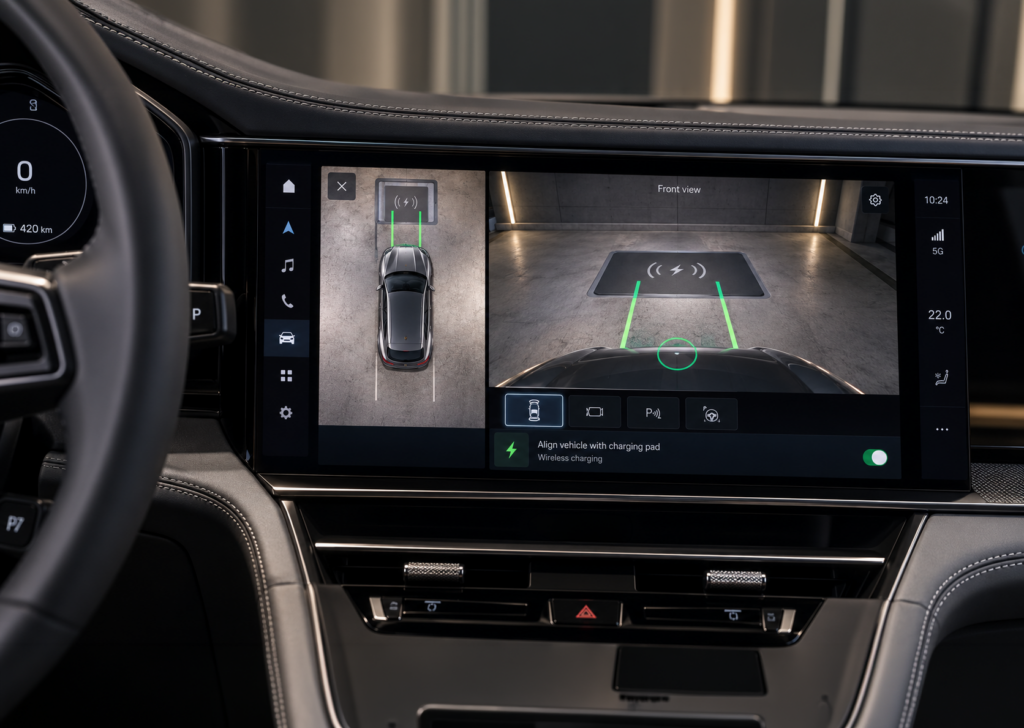
What happens if something lands on the pad?
Porsche has built in safeguards for exactly that. The system uses motion sensors and foreign-object detection, and Porsche says charging stops automatically if a person or animal approaches the vehicle or if a metallic object on the pad begins to heat up.
That matters because the charging area needs to stay controlled while energy is moving between the ground and the car.
Is Porsche the start of something bigger?
Possibly. Wireless EV charging itself is not new, and industry standards have been developing for years. SAE International’s J2954 standard covers areas including safety, performance, interoperability and electromagnetic compatibility for wireless charging of light-duty EVs. It supports both private home charging and public wireless charging.
What is interesting now is that the technology is moving from research, pilots and prototypes into something a customer can actually order on a production car. Porsche says the Cayenne Electric is its first model to offer the system, with availability beginning in Germany and other European markets before a staged international rollout. That does not mean charging cables are about to disappear, but it does make wireless charging feel a lot less like “one day” technology.
Quick Q&A
Questions, answered.
Tap a question for a quick, evidence-based answer.
Does wireless EV charging work like phone charging?
Broadly, yes. Both use electromagnetic induction to move energy between two coils without a physical charging cable.
How fast is Porsche’s wireless charging?
Up to 11 kW. That is similar to many home AC wallboxes, so it is mainly designed for home and overnight charging.
Is it completely automatic?
Mostly. The driver parks over the floor pad, the vehicle helps with alignment and charging starts automatically once everything is correctly positioned.
Is wireless charging less efficient?
It can be. Porsche quotes about 90% efficiency for its system, so some energy is lost during the wireless transfer.
Will every EV get wireless charging soon?
Not yet. The technology exists and standards are developing, but adoption will depend on cost, compatibility and whether manufacturers and drivers see enough benefit.
A quick reality charge
The cable is not dead. But it just got some competition.
Wireless EV charging is unlikely to replace every charger anytime soon, especially fast public charging. But for a car parked in the same place every night, the appeal is easy to understand.
Park. Walk away. Charge. For once, EV charging may actually become less noticeable, and that might be the point.