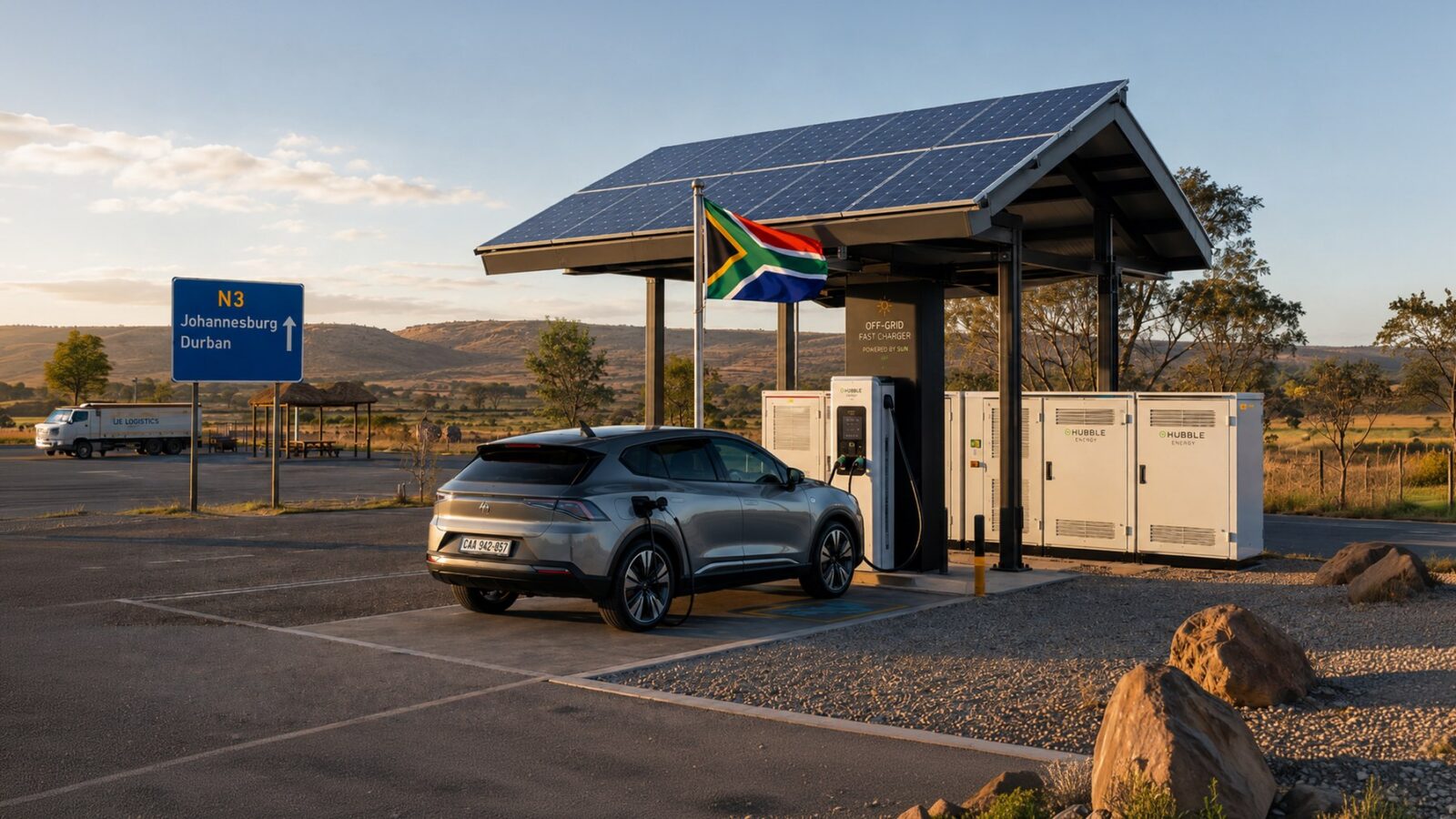
Yes. And South Africa is already testing what that can look like at scale.
Along the busy N3 route between Johannesburg and Durban, new EV charging stations are running entirely off-grid, using solar power and battery storage instead of relying on the national electricity network.
It is an interesting answer to a very South African charging challenge: how do you expand electric mobility when access to reliable grid power is not always guaranteed?
What does off-grid EV charging actually mean?
Most public EV chargers take their electricity from the same grid that powers nearby homes and businesses.
An off-grid station works differently.
At CHARGE’s new N3 sites, solar panels generate electricity locally. That energy is combined with on-site battery storage, creating a small independent energy system, often called a microgrid.
The charger can therefore supply an EV without drawing electricity from the national grid. So yes, in this case, your electric car is effectively being charged by energy generated right there at the station.
Why does that matter in South Africa?
South Africa already has hundreds of public charging points, but infrastructure is concentrated mainly around larger urban areas. Expanding charging along major routes and into less-connected areas remains one of the challenges for wider EV adoption.
Electricity supply has also historically been a concern. Reuters reported that ageing grid infrastructure and periods of power cuts have complicated electrification efforts in the country, making grid-independent charging an interesting alternative.
That gives off-grid charging two jobs. It can put chargers in places where drivers need them, while reducing how much those chargers depend on local grid capacity.
Solar power alone is not quite enough
There is one obvious problem with putting solar panels above a charger. The sun does not always shine when someone needs to charge.
That is where battery storage comes in. Electricity generated during sunny periods can be stored at the station and used later, allowing the charging hub to continue operating when solar generation drops.
The two N3 stations combine solar-powered microgrids with battery storage and can each charge up to eight vehicles simultaneously. They include three direct current (DC) chargers with six charging outlets and two alternating current (AC) chargers.
CHARGE says a typical compatible EV can go from around 20% to 80% in about 30 minutes at its DC chargers, although the actual time depends on the vehicle and battery.
Where are these chargers?
The first two stations are positioned along the N3, one of South Africa’s major passenger and freight routes.
CHARGE N3 Roadside is in the Free State, roughly 180 km from Johannesburg. CHARGE N3 Tugela is in KwaZulu-Natal, around 200 km from Durban.
That makes the project especially relevant for one of the questions surrounding EV adoption in a large country: long-distance travel.
Public charging concentrated in cities is useful for urban drivers. A charging network also needs to connect those cities if electric cars are going to work comfortably for longer journeys.
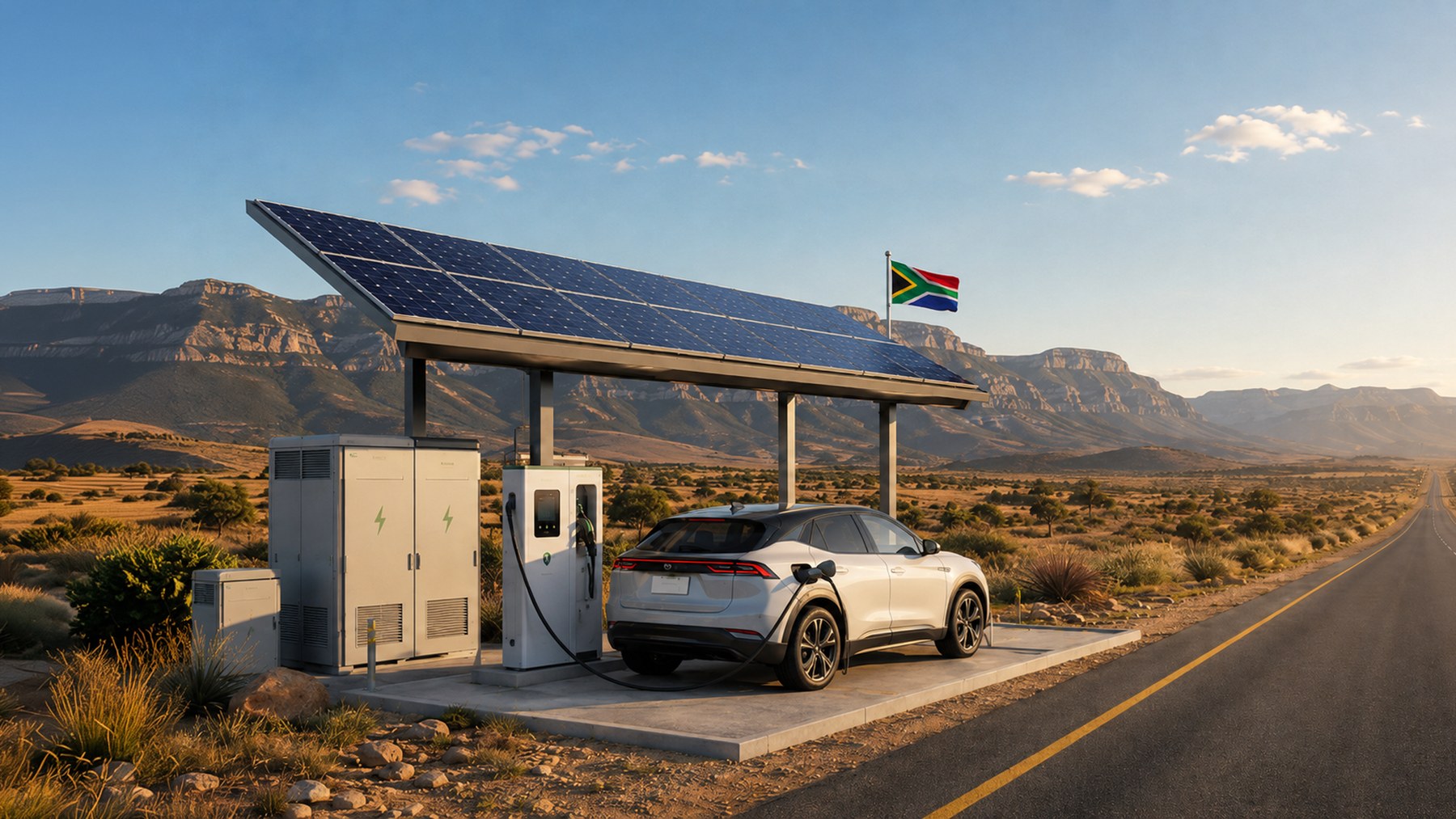
Could this work across South Africa?
That is the plan, but the network is still developing.
CHARGE says the two N3 sites form part of a planned 120-station national off-grid network, with expansion to other major routes expected over time.
An independent July 2026 assessment from South Africa’s uYilo National Electric Mobility Programme also said the country’s off-grid solar charging network could expand to nearly 100 locations over the following two years.
Those are plans and projections, rather than 100-plus stations already operating today. What is already working is the basic concept: generate renewable electricity on-site, store it and use it to charge vehicles without a grid connection.
Does this mean every EV charger should go off-grid?
Probably not.
In cities and areas with strong electricity infrastructure, connecting chargers to the grid can still make perfect sense.
Off-grid charging becomes particularly interesting where a new grid connection would be difficult, expensive or unreliable, or where renewable generation is readily available.
South Africa’s approach shows that EV charging does not necessarily need the same infrastructure model everywhere. Sometimes the charger can bring its own power supply.
Could the same idea work for electric trucks?
Yes, and that is another reason the South African project is interesting.
The N3 is not just a passenger-car route. It is one of the country’s important freight corridors.
CHARGE says its network is being developed for both passenger vehicles and commercial fleets. The company has also demonstrated solar-powered charging for heavy electric trucks.
Charging a truck requires considerably more energy than charging a passenger car, so proving that an off-grid system can support both makes the concept more ambitious than a small solar charger in a car park.
Questions, answered.
Tap a question for a quick, evidence-based answer.
Can an EV charger work without an electricity grid connection?
Yes. An off-grid charger can generate electricity locally, for example with solar panels, and combine it with battery storage to provide power when vehicles need to charge.
Are there off-grid EV chargers in South Africa?
Yes. Fully off-grid, solar-powered charging stations are operating along the N3 between Johannesburg and Durban.
Do solar EV chargers only work when the sun is shining?
No. Battery storage can hold electricity generated by the solar panels and make it available when solar production is lower.
Can off-grid chargers support fast charging?
Yes. The N3 stations include DC fast chargers, alongside AC chargers, and use solar generation plus battery storage to supply them.
Is South Africa building more of them?
Yes, although the network is still being rolled out. CHARGE says its longer-term plan is for a national network of 120 off-grid charging sites.
The charger can bring its own power.
EV charging usually makes us think about plugging a car into the electricity network. South Africa is showing that there is another option.
Generate the electricity where the charger is, store it there and use it when a driver arrives.
That will not replace every grid-connected charger. But on long routes and in places where electricity infrastructure creates an extra hurdle, bringing the power source to the charger could help bring EV charging to places it might otherwise struggle to reach.