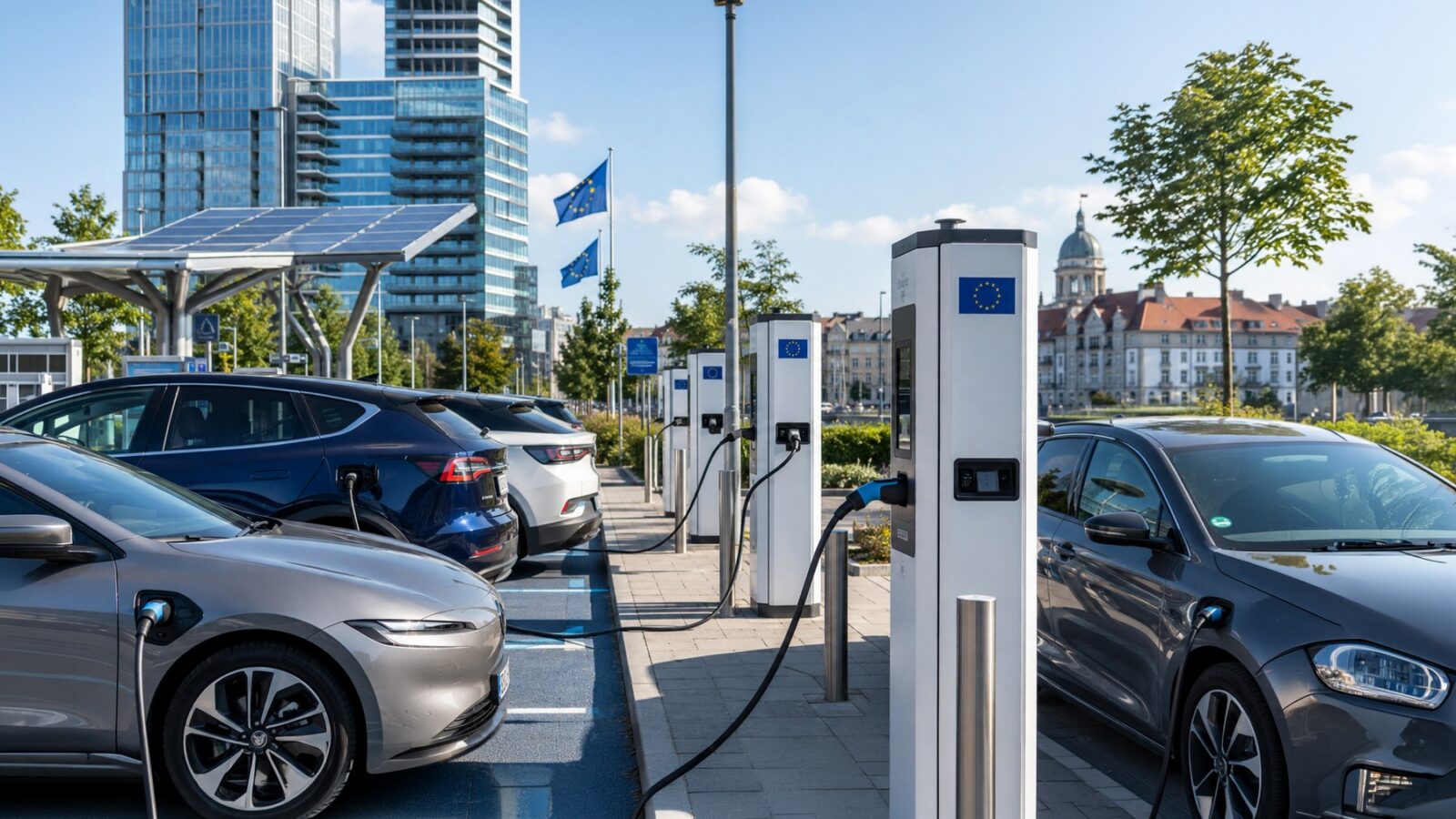
The European Union had around 1.1 million public EV chargers by the end of 2025, five times as many as in 2020. That sounds like a major infrastructure milestone, but the number alone does not tell you how easy charging will feel in everyday life.
Where those chargers are, how fast they charge, whether they are available when you need them and how easy they are to use all matter too.
How quickly is Europe’s charging network growing?
Quite quickly. Transport & Environment reported in July 2026 that the number of public EV chargers in the European Union had reached 1.1 million by the end of 2025, around five times the 2020 level.
Data from the European Alternative Fuels Observatory also tracks publicly accessible charging infrastructure across EU Member States. That growth matters because access to charging is one of the biggest practical questions for people considering an electric car.
Does Europe now have enough EV chargers?
At national level, most EU countries are already above one important regulatory benchmark. The EU’s Alternative Fuels Infrastructure Regulation, known as AFIR, sets charging requirements based partly on the number of electric cars registered in each country.
For every battery electric light-duty vehicle in a national fleet, Member States must provide at least 1.3 kW of publicly accessible charging power. Plug-in hybrids have a separate requirement of 0.8 kW per vehicle.
By the end of March 2026, all EU countries except Malta had enough public charging capacity to meet the requirement for fully electric cars. For the EU as a whole, available capacity was around 180% above that fleet-based target.

Why can public charging still feel difficult?
Because a national total does not tell you where the chargers are. Two areas can have the same number of EV drivers and enough capacity on paper, while offering very different real-world experiences.
Location, speed, availability, reliability, payment and price all shape whether a charging point is genuinely useful. Charger count is one measure of infrastructure, not the whole story.
What is the EU doing about the charging experience?
European charging rules increasingly cover more than simply installing charging points. AFIR includes requirements for publicly accessible infrastructure, while newer EU rules aim to improve the availability and consistency of charging data.
In April 2025, the European Commission adopted specifications intended to make alternative-fuel infrastructure information more accessible and interoperable. That matters for the questions drivers want answered before arriving: Where is the charger? Is it available? How fast is it? And what will it cost?
What does 1.1 million chargers mean for an EV driver?
Mostly, it means Europe’s public charging network is no longer a small experimental system. It is becoming large-scale transport infrastructure.
For drivers, however, the practical question remains local. If you are considering an EV, the EU-wide total is less useful than looking at chargers around your home, workplace and regular long-distance routes.
Questions, answered.
Tap a question for a quick, evidence-based answer.
How many public EV chargers are there in the EU?
There were around 1.1 million publicly accessible EV chargers in the European Union by the end of 2025, according to Transport & Environment.
Is Europe’s public charging network growing?
Yes. The EU had around five times as many public chargers at the end of 2025 as it did in 2020.
Does every EU country have enough chargers?
Most countries currently meet the EU’s fleet-based charging capacity requirement. Transport & Environment found that all EU countries except Malta were above that AFIR benchmark by the end of March 2026.
What is AFIR?
AFIR is the EU’s Alternative Fuels Infrastructure Regulation. Among other requirements, it sets minimum publicly accessible charging capacity linked to the number of electric vehicles registered in each Member State.
Does 1.1 million chargers mean charging is easy everywhere?
No. Charger location, speed, reliability, availability and payment experience can all affect how useful the network is to individual drivers.
EV drivers do not charge from statistics.
They charge from the station that is actually available when and where they need it. Europe’s network is expanding quickly and has moved ahead of fleet-based targets in most Member States.
The next question is not only how many chargers Europe can install. It is how useful, reliable and easy to access that network becomes for everyday drivers.